
Topological Quantum Device for Dissipationless Conversion of Thermal Energy into Electrical Power
Quantum Technologies
Ref.-No.: 1201-6430-FG
Background
The recovery of low-grade waste heat remains one of the major challenges in modern energy technology. Conventional thermoelectric generators are based on the Seebeck effect and are fundamentally limited by the coupled transport of heat and charge, resulting in relatively modest conversion efficiencies.
Recent advances in topological quantum materials have demonstrated dissipationless electronic transport through protected edge or surface states. However, these phenomena have largely remained confined to scientific research, and practical devices capable of converting thermal energy directly into usable electrical power have not been available.
The present invention bridges this gap by providing a scalable quantum device architecture that transforms microscopic topological currents into macroscopic electrical output.
Technology
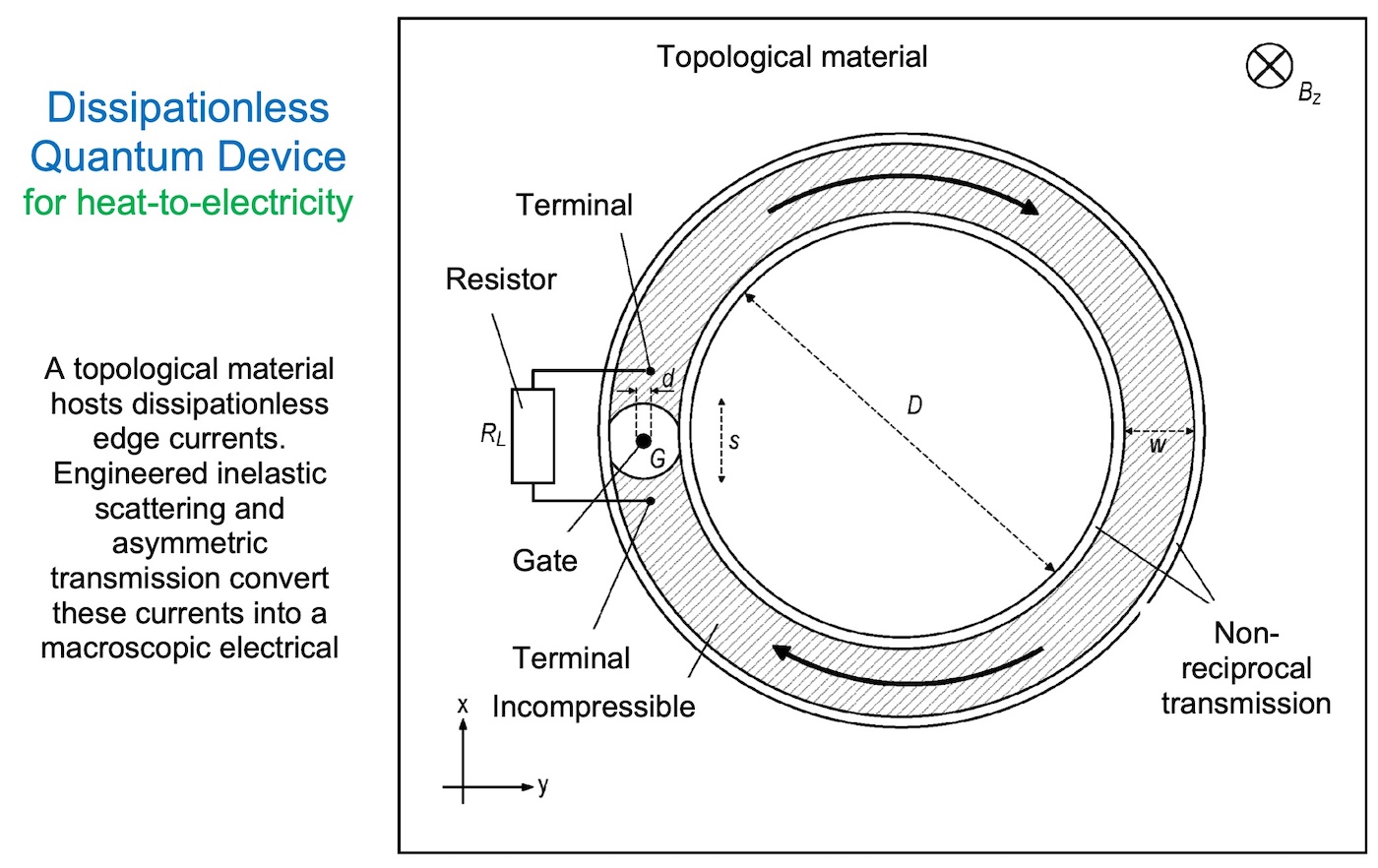
The invention comprises a transmission structure incorporating a topological material connected to at least two electrical terminals. The transmission structure is engineered to generate electron, hole or other quasi-particle currents based on topological transport phenomena. A functional element introduces controlled inelastic scattering within part of the current path. This asymmetric transport mechanism converts thermally excited dissipationless currents into a directed electrical output that can provide usable voltage and current to an external load.
Arrays of multiple quantum devices connected in series or parallel are provided. They enable scalable voltage and current generation for practical energy-harvesting applications. The technology is applicable to quantum Hall, quantum spin Hall, anomalous quantum Hall and three-dimensional topological materials.
Innovative Aspects
- Direct conversion of heat into electrical power using topological quantum transport
- Utilization of dissipationless edge or surface currents
- Engineered non-reciprocal electron transmission
- Controlled inelastic scattering for current rectification
- Macroscopic current generation from quantum transport phenomena
- Scalable device arrays for increased electrical output
- Multiple implementations using different classes of topological materials
- Flexible device geometries including linear, ring-shaped and arbitrary layouts.
Advantages
- Novel energy-conversion principle beyond conventional thermoelectrics
- Potentially very low electrical losses due to topological protection
- Direct harvesting of waste heat
- Modular architecture allowing voltage and current scaling
- High robustness of transport channels against scattering and defects
- Compatibility with various topological material platforms
- Suitable for integration into future quantum and semiconductor devices
- Broad range of possible device geometries and fabrication strategies.
Potential Applications
- Quantum electronics
- Cryogenic instrumentation
- Scientific measurement systems
- Semiconductor devices
- Ultra-low-power electronics
- Space applications
- Advanced sensor systems
- Energy-autonomous microsystems
Patent Information
EP4566160A1, CN119605072A, JP2025528007A
PDF Download
- Ref.-No.: 1201-6430-FG (399.7 KiB)
Contact

Patent- & License Manager
Dr. Franz Gadelmeier
Physicist
+49 171 656 9140
gadelmeier@max-planck-innovation.de