
Specific Detection of ADP-Ribosyl-Linked Ubiquitylation
Nucleic Acid-, Protein and Cell-related Technologies : Nucleic acid related
Nucleic Acid-, Protein and Cell-related Technologies : Protein related
Ref.-No.: 1013-6948-IKF
Background
Post-translational modifications (PTMs) are pivotal regulators of signaling pathways, expanding proteome functionality. ADP-ribosylation (ADPr) and ubiquitylation play central roles in DNA repair, protein turnover, and stress responses. Recent research has uncovered an entirely new class of such signals: ADP-ribosyl-linked ubiquitylation, a composite modification integrating the regulatory power of ADPr and ubiquitylation. Technical hurdles in detecting ADP-ribosyl-linked ubiquitylation by mass spectrometry and western blotting have hampered studies, especially given its transient nature and chemical diversity.
Technology
Researchers at the Max-Planck-Institute for Biology of Ageing have developed a novel protein-based method that overcomes these challenges. They developed a protein domain capable of binding ADP-ribosyl-linked ubiquitylation within amino acid sequences, providing a selective tool for biochemical, cellular, and proteomic applications. This approach advances mechanistic understanding of ADPr-Ub signaling and supports high-throughput diagnostic and drug discovery workflows.
Key Advantages
- Selective, direct detection of ADP-ribosyl-linked ubiquitylation
- For proteomics, western blotting, biochemical assays, and live-cell applications
- Identification of endogenous modification sites by mass spectrometry
- Modular design adaptable to diverse assay formats
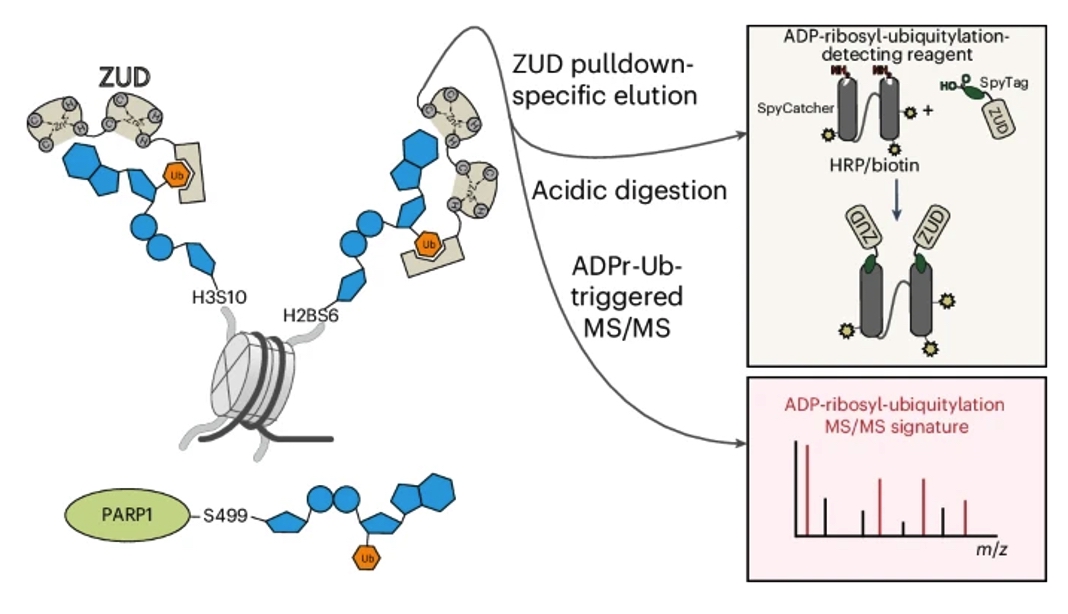
Figure 1 Identification of ADP-ribosyl-linked serine ubiquitylation sites via enrichment using the zfDi19 and ubiquitin interaction motif domain (ZUD). Kolvenbach et al. 2025.
Opportunity
We are seeking industrial partners to further develop and commercialize the technology toward clinical application.
Patent Information
International Patent Application (PCT): WO 2026/180584 A1
Scientific Publication
Kolvenbach et al., Nature Chemical Biology (2025), https://doi.org/10.1038/s41589-025-01974-5
PDF Download
- Ref.-No.: 1013-6948-IKF (451.8 KiB)
Contact

Senior Patent & License Manager
Dr. Ingrid Kapser-Fischer
Nutritionist, M.Sc.
+49 163 88 999 03
kapser-fischer@max-planck-innovation.de