
High-performance magnetic field generator with three-dimensional control and open workspace for medical robotics
Medicine
Ref.-No.: 0105-5581-FG
Background
Magnetic actuation is an enabling technology for remotely controlling medical devices, miniature robots and surgical instruments. However, conventional magnetic field generation systems have important limitations. Electromagnetic coil systems can require high electrical currents, expensive power amplifiers and substantial cooling capacity. Superconducting magnets can generate strong magnetic fields but require cryogenic infrastructure and generally offer limited flexibility in dynamically changing field direction. Permanent magnet systems avoid many of these drawbacks, but existing configurations can obstruct access to the central workspace when magnets or entire magnet assemblies are moved. This is particularly problematic in medical applications, where the patient must remain accessible to imaging equipment, surgical tools, anaesthesia systems and monitoring devices. The invention addresses these challenges through a permanent-magnet architecture that combines strong magnetic fields, flexible three-dimensional control and a largely unobstructed workspace.
Technology
The magnetic field generator comprises at least three groups of magnets, with each group containing at least two magnets. The magnetic moments of the magnets are rotatable around defined axes. The three groups have linearly independent orientations, preferably arranged approximately perpendicular to one another.
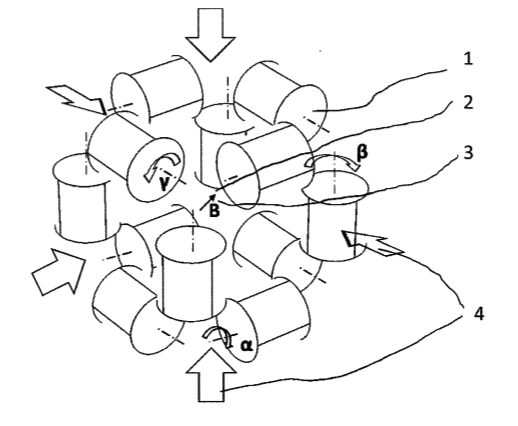 |
1 - Magnets Only three independent angular inputs (labeled as α , β, γ) are needed to change the direction of the field vector B to point in an arbitrary direction in three-dimensional space while also allowing for the adjustment of the B field flux density. |
By coordinating the rotational positions of the magnets, the individual magnetic fields are superimposed to create a resulting magnetic field within the central workspace.
The system allows control of:
- Magnetic field direction in three-dimensional space.
- Magnetic flux density from zero up to a configuration-dependent maximum.
- Rotating and oscillating magnetic fields.
- Magnetic field gradients in suitable configurations.
In a preferred embodiment, the magnets remain at fixed positions relative to the workspace and only their magnetic moments are rotated. This is a major architectural advantage since the central workspace remains accessible while the magnetic field changes direction and magnitude.
The figure shows an arrangement of twelve permanent magnets divided into three groups of four. However, other arrangements including alternative magnet geometries and larger workspaces for accommodating a human patient are also possible.
Innovative Aspects
- Three-dimensional magnetic field control: The direction and magnitude of the resulting magnetic field can be adjusted using coordinated rotations of multiple permanent magnets.
- Permanent-magnet architecture: Strong magnetic fields can be generated without the continuous electrical currents required for conventional electromagnetic coils.
- Open and accessible workspace: The arrangement of magnets along the edges of a cube or related geometry provides access from multiple directions.
- Simplified control architecture: A twelve-magnet embodiment requires only three independent angular control inputs, thus reducing the complexity of the control system.
- Compatibility with medical instruments: The workspace can accommodate patients, imaging equipment, monitoring systems and surgical instruments.
- Actuation of tethered and untethered devices: The generated magnetic field can control devices containing magnetic elements, including freely moving microrobots and magnetically steerable instrument tips.
Potential Applications
- Medical microrobotics
- Magnetically guided catheters and surgical instruments
- Image-guided interventions
- Soft robotics and wireless actuators
- Laboratory automation and precision instrumentation
Patent Information
EP3793462B1, JP7515405B2, JP7725655B2, US12257016B2
PDF Download
- Ref.-No.: 0105-5581-FG (186.9 KiB)
Contact

Patent- & License Manager
Dr. Franz Gadelmeier
Physicist
+49 171 656 9140
gadelmeier@max-planck-innovation.de